|
|
home - for other articles
WHY DO PHARMACEUTICAL DRUGS INJURE AND KILL SO MANY PEOPLE?
Are WE the real guinea-pigs?
Some revealing statistics:
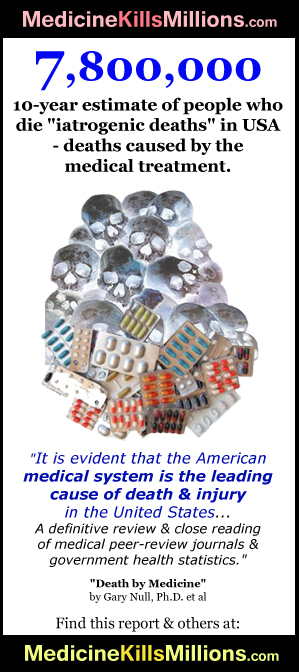
In 1994 a study reported in the Journal of the American Medical Association
showed that modern medicine causes 180,000 deaths each year in
the USA. (1) Most of these are caused by prescribed pharmaceutical
drugs. For example, a 1998 study in the Journal of the American Medical
Association stated that in 1994 in the USA, "2,216,000 hospitalized
patients had serious Adverse Drug Reactions and 106,000 had fatal Adverse
Drug Reactions, making these reactions between the fourth and sixth
leading cause of death." (2) In other words, modern medicine is officially
considered to be a leading cause of death.
These astronomical figures, printed in a conservative medical journal,
are in spite of the fact that a large number of pharmaceutical drug damages
are never reported or registered.
Since
1961, the total number of "safety-tested" medical preparations marketed
worldwide has risen to over 200,000. Approximately 15,000 new preparations
are marketed each year, while some 12,000 are withdrawn.(3)
The United States has the greatest annual sickness-care expenditure of
any nation; $912 billion in 1993 alone.(4) If money and medical treatment
equals health then one would expect the United States to be the healthiest
of nations. However, as of 2006 the USA ranks at only number 48 in the
world for life expectancy at birth.(5)
Of course, a percentage of drug damages are due to the incorrect administration
of drugs by physicians and patients. But how are harmful pharmaceutical
drugs allowed onto the market in the first place, and why do we have so
much faith in them? Pharmaceutical transnationals defy the intent of laws
regulating safety of drugs by bribery, false advertising, unsafe manufacturing
processes, smuggling and international law evasion strategies. But most
of all they make dangerous drugs appear safe through the use of fraudulent
and flexible 'safety-tests', the subject of this article...
Fraud in Clinical Trials - Human Tests.
Drug companies can easily arrange appropriate clinical trials by paying
a researcher to produce the desired results that will assist the intended
application of the drug. The incentive for researchers to fabricate data
is enormous. As much as $1000 per subject is paid by American companies
which enables some researchers to earn up to $1 million a year from drug
research.(6) And they know all too well that if they don't produce the
desired data, the loss of future work is inevitable. Unfortunately, because
of secrecy, most fraud in clinical trials is unlikely to be detected.
However, cases of data-fabrication in clinical trials have been uncovered
where, for example, "patients who died while on the trial were not
reported to the sponsor....Dead people were listed as subjects of testing...
People reported as subjects of testing were not in the hospital at the
time of tests..." and where "Patient consent forms bore dates indicating
they were signed by the subjects after the subjects had died."(7)
Even if data from clinical trials is not falsified, it is often of little
worth, because they are not performed appropriately. Trials involve relatively
small numbers of people and the subjects taking part usually do not represent
those who will use the drug after its approval; so many harmful effects
of a new drug appear only when it has been marketed.
Fraud in Vivisection - Animal Tests.
In 2004, the British Medical Journal published an article titled
"Where is the evidence that animal research benefits humans?" It states:
"the public often consider it axiomatic that animal research has contributed
to the treatment of human disease, yet little evidence is available
to support this view." (8) After 150 years of animal research, literally
billions of animals used, billions of taxpayer dollars spent, and regular
articles in the commercial media that claim animal research benefits humans,
this revelation might shock you. Let's look at why one of the world's
leading medical journal states "yet little evidence is available to support
this view"; the view that animal research has contributed to the treatment
of human disease.
The problem of inappropriate and flexible testing of drugs and chemicals,
that we saw above regards clinical trials, is even more pronounced with
the use of so-called animal 'models'; a practice termed vivisection. For
instance, the fact that the animal is relatively healthy before the experiment
means that disease and or trauma has to be induced by violent and artificial
means. This bears no relation to the spontaneous ways in which humans
develop illness, often through a faulty lifestyle and diet.
For example, consider the case of osteoarthritis, a human degenerative
disease resulting in grotesque and painful deformities of the joints.
How do researchers attempt to mimic human lameness in dogs, cats, sheep
and pigs? Joints are beaten with hammer blows, injected with irritating
liquids, subjected to ionising radiation and/or dislocated. It is obvious
that the resulting fractures, haemorrhages, thromboses, contusions and
inflammation bear no relation to human osteoarthritis, "which is a local
manifestation of a generalised illness of the collagen."(9)
The fact is, if you had a new possible treatment for humans with cancer
would it make sense to test it on humans who do not have cancer?
No, because there are tremendous differences in metabolism which would
produce very different results. The people without cancer will react very
differently to the treatment than the people with cancer. It is even more
absurd to think that test results from healthy members of one species,
or from those with artificially induced symptoms, can be applied to another
species. Drugs tested on such artificially diseased non-human animals
cannot possibly yield results relevant to a spontaneous, naturally occurring
human disease.
Moreover, there is no true correlation between different species.
For example, arsenic kills humans but is harmless to guinea-pigs, chickens
and monkeys; Digitalis which is used to lower blood pressure in humans
dangerously raises the blood pressure of dogs; Penicillin kills guinea-pigs;
Chloramphenicol damages the blood-producing bone marrow in humans, but
in no other animal: Many common laboratory animals such as dogs, cats,
rats, hamsters and mice, do not require dietary intake of vitamin C. This
is because their bodies produce it of their own accord. However, if you
deprive humans, guinea-pigs and some primates of dietary vitamin C they
will die of scurvy.
There are enough of these species differences to fill a book.(10) In
the words of former animal researcher Professor Pietro Croce, "No substance
is toxic in itself, but only according to the species."(11)
Not only are there differences between species, but even individuals
of the same species react differently to a substance. For example,
research carried out at the University of Bremen, published in a paper
titled "Problems of activity threshold in pharmacology and toxicology"
found:
1. In ionising radiation -- young animals react differently from older
ones. In reactions to Tranquillisers -- again, young and old animals react
differently.
2. In the common method of testing pharmaceuticals and chemicals, the
Lethal Dose 50% test, it was found that in the experiments carried out
in the evening almost all the rats died: in those carried out in the morning
all of them survived. In the tests carried out in winter, survival rates
were doubled in contrast to those carried out in summer. In tests carried
out on mice overcrowded together in cages, nearly all of them died, while
those carried out on mice in normal conditions, all the mice survived.
The authors of this research, themselves animal researchers, concluded:
"If such trifling environmental conditions bring about such widely differing
and unforeseeable results, this means that animal experimentation cannot
be relied upon in assessing a chemical substance and it is all the
more absurd to extrapolate to problems of human health results which are
intrinsically wrong."(12)
Numerous medical historians such as Hans Ruesch and Dr. Robert Sharpe,
have documented that the true medical progress of the past was achieved
through scientific and ethical study of the real world of natural human
disease, and not from the artificial world of the experimental
animal laboratory.(13) For a quick summation of some of medical history,
see these articles by by Dr Beddow Bayly
and Dr Charles Bell.
How Many Pharmaceutical Drugs Do We Really Need?
Why do drug companies rely on such unreliable and dubious methods for
testing drugs? The answer is simple. If drugs were tested properly using
true scientific methods, such as in vitro cultures of human cells and
properly carried out human clinical trials, the vast majority of them
would not be approved for marketing because their harmfulness and ineffectiveness
would be all too apparent.
For instance, in 1981 the United Nations Industrial Development Organisation
(UNIDO) in collaboration with the World Health Organisation (WHO), published
a list of a mere 26 drugs, from the 205,000 marketed drugs, that were
considered "indispensable", with 9 being more indispensable than the others.(14)
Other medical commissions in Chile 1972, and Sri Lanka 1978, came to similar
findings, that there are not more than a few dozen drugs worth keeping.
However, both existing governments were ousted shortly there-after by
US backed forces. They were replaced with administrations open to American
trade and the products of the chemical-pharmaceutical industry.(15)
This should cause anyone who thinks that we need more drugs to reconsider
their opinion. It is plain to see that inconsequential and ambiguous methods
of drug-testing are essential to protect the astronomical profits of the
pharmaceutical industry.
Drug Companies Make These Admissions!
If you have difficulty accepting this explanation then consider the following
statement from Eli Lilly's August 1993 Prozac 20 Consumer Product Information
pamphlet:
"There can be no such thing as absolute safety with prescription medicines.
Individual patients sometimes react differently to the same dose of the
same medicine and it is possible that some unwanted side effects will
not be known until a medicine has been widely prescribed for a number
of years."
If they admit that even individuals of the same species react differently
to an identical product, then why test on other species?
Dr Herbert Gundersheimer, one of many doctors against vivisection, explains:
"Results from animal tests are not transferable between species
and therefore cannot guarantee product safety for humans... In reality
these tests do not provide protection for consumers from unsafe products,
but rather are used to protect corporations from legal liability."
(16)
When people are damaged by unsafe products (such as pharmaceutical drugs,
industrial and household chemicals, cosmetics ...etc.) and attempt to
take legal action, manufacturers can claim to have adhered to "safety"
tests and are thus absolved of having consciously marketed a harmful product.
Thalidomide: A Case Example
Children of Thalidomide with artificial limbs.
This is what happened in the case of Thalidomide, a drug which after
years of extensive animal tests was marketed as a perfectly safe tranquilliser
for pregnant mothers. The end result: more than 10,000 grossly deformed
babies. During the lengthy trial of the manufacturers in 1970, numerous
court witnesses, all animal experimenters, stated under oath that the
results of animal experiments are never valid for human beings. (17)
One of these experts was the Nobel Prize winner Ernst Boris Chain who
co-discovered the anti-bacterial effects of penicillin. According to the
court records on 2 February 1970 he stated:
"No animal experiment with a medicament, even if it is tested on several
animal species, including primates, under all conceivable conditions,
can give any guarantee that the medicament tested in this way will behave
the same in humans: because in many respects the human is not the same
as the animal."(18)
Because they had performed the required animal safety-tests, and because
these did not show evidence of any danger, the manufacturers of Thalidomide
were found not guilty by the court of consciously marketing a harmful
drug.
This is the real value of animal experiments. Firstly, they can
be manipulated, whether consciously or unconsciously, to produce results
favourable to a financial backer.
Consider this statement from Dr Irwin Bross, former Director of the largest
cancer research institute in the world, the Sloan-Kettering Institute:
"The virtue of animal model systems to those in hot pursuit of the
federal dollars is that they can be used to prove anything
- no matter how foolish, or false, or dangerous this might be. There is
such a wide variation in the results of animal model systems that there
is always some system which will 'prove' a point. Fraudulent methods of
argument never die and rarely fade away. They are too useful to promoters..."
(19)
Secondly, as explained above by Dr Herbert Gundersheimer, animal tests
then serve as legal protection for corporations when their products kill
and injure people.
It is worthy of note that Professor S.T.Aygun, a virologist at the University
of Ankara, who uses only the so-called 'alternative' non-animal research
methods, discovered the danger of Thalidomide to humans and Turkey was
spared the tragedy.(20)
Birth Defects Skyrocket
The (incredible) reaction to the Thalidomide tragedy by the pharmaceutical
lobby was that it was a 'rare exception' and that it 'emphasises a need
for more rigorous animal testing, not less.' This explanation was accepted
by most people. So animal testing increased, along with the output of
'safety-tested' drugs. The consequences of this? In the 1950s in the Federal
Republic of Germany, 3 out of every 100,000 babies were born malformed.
By the 1980s, 500 out of every 100,000 were born malformed.(21)
This is more than a 100-fold increase.
In the United States birth defects increased more than 350% in 25
years. In the late 1950s, 70,000 American babies were born with birth
defects every year. In the 1980s this toll reached 250,000 a year. (22)
The reason for this increase in human birth defects is known. A survey
by doctors in West Germany revealed that 61% of malformations in new-born
children and 88% of all stillbirths are attributable to the damage caused
by drugs taken by the mother during pregnancy. (23)
Remember, all these drugs were marketed after
being declared "safe" through extensive animal testing.
Why do people believe so firmly in vivisection? The answer to this lies
in their education.
Drug Lobby Influence on Education & The Media
With many of the world's major drug companies under its control, the
Rockefeller organisation has, since the early part of this century, been
the largest single private source of funding for medical science and education
in the United States and Britain. It is a major contributor of funding
in many other countries. The aim of this lavish funding for our education
is to produce a curriculum designed to indoctrinate students with beliefs
favourable to the profits of the pharmaceutical-chemical industry. Only
colleges and medical facilities that advocate the massive consumption
of chemical drugs, "safety-tested" on animals, as the secret to health,
are recipients of drug company finance. Drug companies also exercise a
dictatorial influence over the mass-media, through ownership and advertising
revenue, as well as upon party politicians through 'donations'. Meanwhile,
doctors who heal by inexpensive natural means, thereby threatening pharmaceutical
profits, are decried as quacks, driven out of the country or into jail.
(24)
Perhaps the most revealing point, however, is that the founder of the
Rockefeller dynasty, John D Rockefeller, lived in excellent health to
the age of 98 as did his son John D Jr., who died aged 86. What was their
secret to a long healthy life? Both attributed this to a frugal diet of
natural food, the advice of a homeopathic doctor only, and the complete
avoidance of synthetic drugs! (25)
In summary:
The most powerful corporations in the world do not want us to know the
truth about pharmaceutical drugs and drug-testing even if our lives depend
on it. And of course, they do. As the drug companies acknowledge, it means
that every time we take a drug or are exposed to chemicals in our food
and environment, we are the real guinea-pigs.
+ + + + + + + +
home - for other articles
Recommended Organisations:
Physicians Committee
for Responsible Medicine: Group of doctors, physicians and
health practitioners promoting good health through real science. http://www.pcrm.org
Doctors and Lawyers for Responsible Medicine: http://www.dlrm.org/
Campaign
Against Fraudulent Medical Research (CAFMR): Great
archive of articles. Information that the pharmaceutical-chemical industry and their
mass media do not want us to know: medical history, medical fraud, psychiatric abuses,
vaccination damage coverups, behind sudden infant death syndrome (SIDS) etc. http://www.pnc.com.au/~cafmr
CIVIS – The Hans Ruesch centre for information on vivisection: http://www.VivisectionFraud.com
+ + + + + + + +
References:
(1) Lucian Leape, "Error in medicine", Journal of the American Medical
Association (JAMA), 1994, vol. 272, nr 23, p. 1851.
(2) Lazarou J, Pemeranz B, Corey PN. "Incidence of adverse drug reactions
in hospitalized patients: a meta-analysis of prospective studies," JAMA,
1998, vol. 279, nr 15, pp. 1200-1205.
(3) Hans Ruesch, Naked Empress-the Great Medical Fraud, CIVIS, Massagno/Lugano,
Switzerland, 1992, p.12.
(4) Arthur Baker, Awakening Our Self-Healing Body-A Solution to the Health
Care Crisis, Self Health Care Sytems, LA, California, 1994, p. 5.
(5) See http://www.nationmaster.com/graph-T/hea_lif_exp_at_bir_tot_pop
(6) John Braithwaite, Corporate Crime in the Pharmaceutical Industry,
Routledge & Kegan Paul, London, 1984, p.105.
(7) ibid., pp.51-52.
(8) British Medical Journal, 2004;328:514-517 (28 February), doi:10.1136/bmj.328.7438.514
(9) Pietro Croce, Vivisection or Science-a Choice to Make, CIVIS, Switzerland,
1991a, p.37.
(10) ibid, p.22-23.
(11) Piedro Croce, "That's Why I am Against Vivisection", CIVIS Foundation
Report, Massagno/Lugano, Switzerland, 1991b, nr 7, p.1.
(12) Croce, op. cit., 1991a, p.19.
(13) Hans Ruesch, Slaughter of the Innocent, CIVITAS Publications, Hartsdale
NY, 1991, pp. 147-287; Robert Sharpe,The Cruel Deception, Thorsons Publishing
Group, Wellingborough, U.K.1988.
(14) Hans Ruesch, Naked Empress, op. cit.,1992, p.191.
(15) ibid., p.92-96,191.
(16) Herbert Gundersheimer, 1988, in 1000 Doctors Against Vivisection
(and Many More), Hans Ruesch (Ed.), CIVIS, Switzerland, 1989, p.29.
(17) Hans Ruesch, Slaughter of the Innocent, op. cit., 1991, pp. 359-367.
(18) Werner Hartinger in CIVIS International Foundation Report, Hans
Ruesch (Ed.), CIVIS Massagno, Switzerland, 1991, nr 11, p.3.
(19) Irwin Bross, "Animals in cancer research: a multi-billion dollar
fraud" in "Fundamental and Applied Toxicology", Nov. 1982, cited in "1000
Doctors (and Many More) Against Vivisection" (Hans Ruesch, Ed.), CIVIS,
Massagno, Switzerland, 1989, p.70-71
(20) Hans Ruesch, Slaughter of the Innocent, op. cit., 1991, p. 367.
(21) ibid., pp-365-366.
(22) Javier Burgos, Hidden Crimes (Film), SUPRESS, Pasadena, California,
1986.
(23) Croce, op. cit., 1991a, p.52.
(24) Ruesch, Naked Empress, op. cit., 1992, p.97-119.
(25) ibid., p.115-116.
|
to top

to top
to top
to top
to top
to top
to top
|